Tuesday, March 22, 2016

ANSWERS for (17 MAR 16) Sub Questions of Week

Related information, photo(s) and links for questions are found in the original posting..

ANSWERS Submarine Questions of the Week


1  -  What is the significance of Ice Camp Sargo's name?  ANS: USS Sargo's (SSN-538) arctic history.

2 -   In the photo of Ice Camp Sargo (here): 
-  (a)  From what direction was the wind coming?
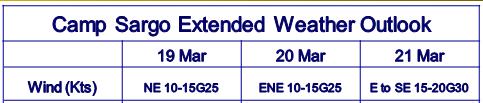
  ANS:  Unknown, as we do not know exactly when the photo was taken. However, a subjective guess based upon March winds may help.
-  (b)  Which of the flags shown represent nations who have claimed portions of the extended continental shelf under UNCLOS? ANS:  Canada and Norway. 
- (c) Which flags represent nations who have not made such claims? ANS:  U.S.A.
- (d) Is there an UNCLOS claimant not participating in ICEX 16?  ANS: Russia
 
3 - Two U.S. subs are deployed for ICEX 16; which subs (names & hull numbers)?
ANS: The Los Angeles-class submarines, USS Hartford (SSN 768) from Groton, and USS Hampton (SSN 767) from San Diego, are conducting maneuvers, data collection and training matters. 
 
4 -  Which of the following are not assigned ICEX 16 participants: Alaska Air National Guard assets, MIT students, Mobile Diving Salvage Unit 2, Norwegian personnel, SEAL Delivery Vehicle Team, Royal Navy personnel, Royal Canadian Navy and Air Force personnel, Russian contingents, the USCG?  
ANSRussian contingents may be actively snooping, but not as ICEX participants.
 
5 - What seems strangely out of place in the © Edgar Su / Reuters ICEX-16 unrelated, U.S. submarine photo below (subjective answer)? 
ANS:  M.E. has lightened the published photo to underscore issues raised below:

Submarines are always silent and strange.

Labels: , , , , , , , , , , , , , , ,

|

Thursday, March 17, 2016

Sub Questions of the Week: 17 MAR 16

Background

In a temporary departure from past Questions of the Week, which required objective answers, this edition also requires a few subjective answers to consider. 

Inspiration for this week's change comes from Ice Station SARGO, a temporary ICEX 16 command center built upon an arctic ice floe (a sheet of floating ice):

Sub Questions of the Week

1  -  What is the significance of Ice Camp Sargo's name?

2 -   In the photo of Ice Camp Sargo below:
-  (a)  From what direction was the wind coming?
-  (b)  Which of the flags shown represent nations who have claimed portions of the extended continental shelf under UNCLOS?  - (c) Which flags represent nations who have not made such claims? - (d) Is there an UNCLOS claimant not participating in ICEX 16?

3 - Two U.S. subs are deployed for ICEX 16; which subs (names & hull numbers)?

4 -  Which of the following are not assigned ICEX 16 participants: Alaska Air National Guard assets, MIT students, Mobile Diving Salvage Unit 2, Norwegian personnel, SEAL Delivery Vehicle Team, Royal Navy personnel, Royal Canadian Navy and Air Force personnel, Russian contingents, the USCG?

5 -
What seems strangely out of place in the © Edgar Su / Reuters ICEX-16 unrelated, U.S. submarine photo below (subjective answer)? 

ANSWERS:  Tuesday, 22 MAR 16

Submarines are always silent and strange

Labels: , , , , , ,

|

Wednesday, October 23, 2013

Coast Guard must think it's safer. Navy thinks, "Why Not!"

NORFOLK - Sailors standing watch topside aboard Navy submarines are now required to wear life vests at all times following a drowning this summer at Norfolk Naval Station.


"The new life-jacket requirement comes despite the fact that Acosta apparently broke existing safety guidelines when he stepped off the nonslip surface of the submarine without first donning a flotation device, according to the report.

The 21-year-old sailor passed a Breathalyzer test and reviewed safety rules before assuming duty on a topside roving patrol that Saturday. Armed with an M16 rifle and a pistol, Acosta was walking along the rear of the sub when another sailor saw him step outside the safety ropes and off the boat's nonslip surface. A moment later, he fell from the stern.

The report noted that the Boise did not have complete safety lines installed at the time of the incident because of "a material deficiency."

Additionally, the investigator noted that having rescue divers assigned to the naval station's civilian emergency response team "would have been invaluable."

The investigation was conducted by Submarine Group 2 in Groton, Conn. and obtained through a Freedom of Information Act (FOIA) request.

In a coincidence, Molten Eagle recently learned that Medevac teams on subs are also now required to wear safety head gear.

Something (submarine experience) tells M.E. the life vest decision is going to have unintended safety consequences.  Let's hope M.E. will be wrong.  If not, the unavailable safety line alone (a cited "material deficiency") may have saved the young sailor, who was seen stepping outside the safety ropes, off the boat's nonslip surface and subsequently slipping over the stern.  No disciplinary actions were recommended as a result of the accident.

Submarines are always silent and strange.

Labels: , , , , , , ,

|

Saturday, July 13, 2013

Bravo! Navy!

Background

THEN ...
Since Sept. 11, 2001, the Coast Guard had escorted Sub Base submarines to and from sea. Coast Guard crews were armed and trained to protect the submarines against attacks by terrorists or saboteurs.

NOW ...
A Coastal Riverine Force  reserve squadron based in Newport, Rhode Island, now has a platoon based in Groton. Sailors using four boats will protect the submarines, said Lt. Cmdr. Charity Hardison, spokeswoman for the Navy Expeditionary Combat Command, which oversees CORIVGRU 2.


Points to Ponder

According to the official line reported here, the Coast Guard got the sub escort gig after Sept 11, 2001, by offering to do it because the Navy was busy preparing for combat in Afghanistan and later, in Iraq.

+  We know recent sequestration cutbacks are effecting both services, so it might make sense for the USCG to want to give the duty back to the Navy, right?

Well, Navy officials said they also are looking into using their forces to protect submarine transits in Norfolk, Virginia; Bremerton and Bangor, Washington; Mayport and Cape Canaveral, Florida; Kings Bay, Georgia; and San Diego.  

+ We know that the Naval Submarine facilities in Bangor, WA and Kings Bay, GA (underlined above) are support bases (homeports) for TRIDENT ballistic missile submarines. Is this really news? Have not all strategic weapons platforms been appropriately escorted?  Of course they have.

The services have not yet decided on the schedule, or on how the responsibilities for routine escort missions in each port will be divided. The Coast Guard would support the Navy during any contingency or heightened security environment, said  Lt. Cmdr. Brian Badura, spokesman for U.S. Fleet Forces Command.  "This re-leveling of effort is part of that normal process, which is necessary, especially in this financially-constrained environment," he said. ... It costs about $2 million annually to escort the Groton submarines, Badura added. The Navy does not reimburse the Coast Guard.

?  Lt. Cmdr. Badura "told the newspaper [ibid] the threat to submarines from terrorists and saboteurs has not diminished." 

- The words "not diminished" certainly does not rule out an increased threat from terrorists and saboteurs, does it?

What might lead to an increased threat and how might someone know if the threat level actually has increases? Answers to both parts of that question are the same, someone has been eavesdropping and the usual culprits are the only ones not upset about it:

If Osama bin Laden were still alive he’d chalk up this surveillance gone wild as a coup for Al Qaeda. More than a decade after the 9/11 attack it still has the United States living in fear and trading away freedoms for security. This is beginning to look like a war the U.S. is determined to lose, one way or another.  Source: The Toronto Star.  

Submarines are always silent and strange.


Labels: , , , , , ,

|